
Let’s set the scene. Less than 2 months after winning states, with not much time to recover and get caught up with school work, travel volleyball began in force. For a group of Community School of Davidson (CSD) women’s varsity players, the change came quickly. And with much stress.
Traveling to Raleigh for the state championship for one or two matches was one thing but club volleyball is another.
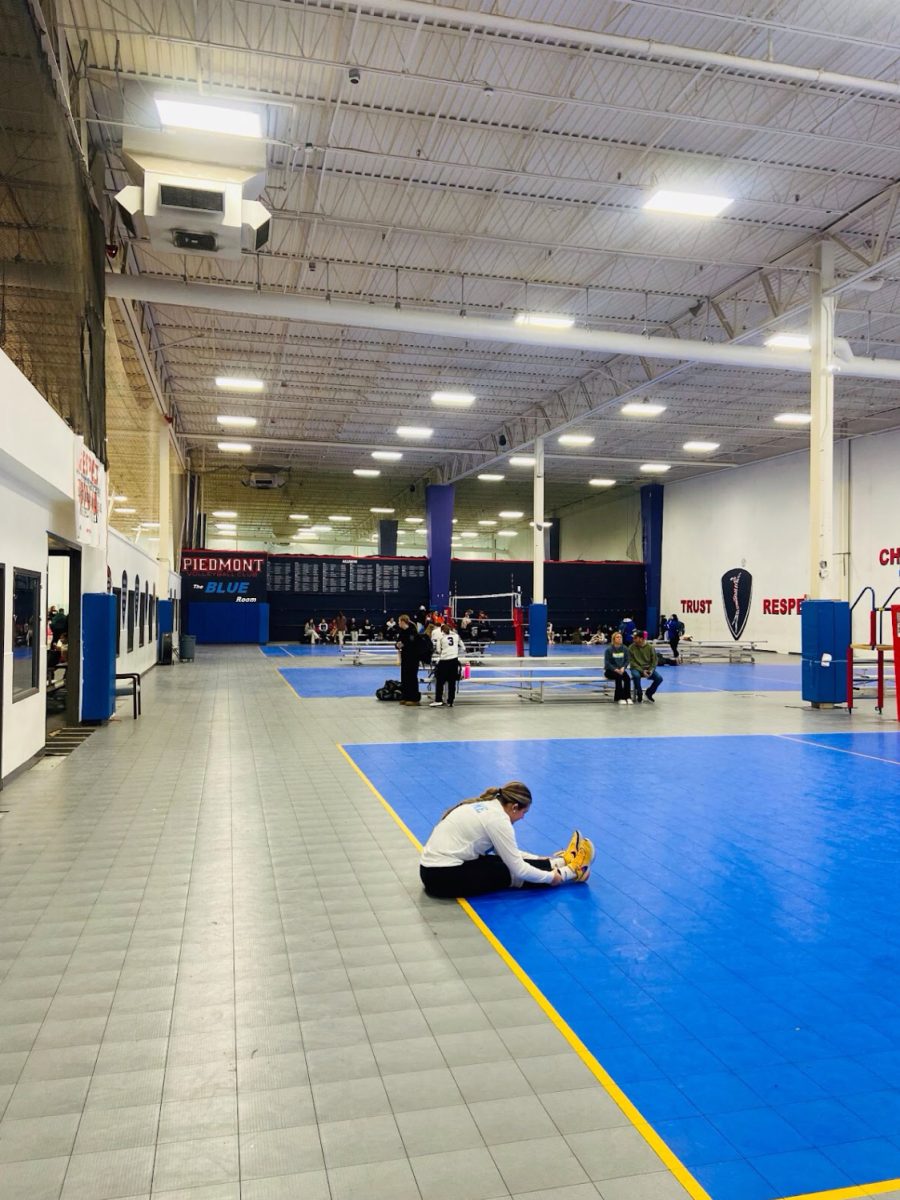
Club volleyball is an all day or all night weekend thing while school ball is a one game match two or three times a week.
Club volleyball isn’t just a sport it’s also a commitment. You contribute so much time and effort into this sport and you’re expected to perform your best at tournaments but these tournaments, with multiple matches over several days, with their physical and mental stresses, test even the best high school athlete.
The demands are monumental. A survey by the National Federation of State High School Associations showed high school athletes often spend at least 20 hours per week on their sport, and for those in club or travel teams the number can rise to 30–35 hours a week similar to a part-time job which overlaps with time for school and studying.
Volleyball tournaments are far different from other sports because you are either playing from before the sun comes up until after the sun goes down. And often well into the night, too. By comparison, a high school volleyball match, or football game, or basketball game, is typically over in two hours.
Volleyball tournaments can be tricky because of scheduling as you go from playing two games in a row to having a 2 hour break, and then playing again. Some players don’t perform as well as they started off from having that large break.
Despite the stresses and challenges, club volleyball tournaments help build many memories. Players learn that you are going to struggle at points and feel like you want to quit and from that you learn to push yourself and become a better player.
“I have made some of my best friends and we connect so well on the court and off and having those connections off the court really helps when we play because we are already so close,” Kelly Rodgers (‘27) said.
One of the key habits that players built is making homework a priority during the week before travel tournaments. Even though it can be really tempting to ignore schoolwork when practices get tough and weekends are packed with games.
Keeping up with other responsibilities is super important for both school and sports success.
The weeks before tournaments are really busy and challenging, especially for seniors. With long practices, conditioning, and getting mentally ready for competition, schedules fill quickly.
To handle this, players use different strategies.
“I use the same resources. My main goal is to do my work throughout the week so I can focus on my tournament that weekend but if I don’t get to all my work I try to do it when my tournament is over or on my way there or home,” Lizzie Shields (‘27) said.
Balancing academics and athletics also help players grow as individuals. They learn how to manage time, stay organized and hold oneself accountable without needing reminders.
Parents of student athletes often notice how their student athletes learn time management as they get more involved in sports.
“I have learned to stay on top of Kennedy as an athlete who travels because I value her academics but also value her playing and want her full focus on the weekends to be on volleyball,” Matthew Donley, father of writer Kennedy Donley, said.
Most importantly, through club sports, players learn that being determined means showing up fully in every area of life, not just the ones they enjoy most.
But with club sports, with busy schedules and lots of travel, the lessons players learn help prepare for future challenges, where discipline, focus and perseverance matter just as much as talent.
Author’s Note —-
My first tournament back playing club after winning state this year was a difficult one. The reality of balancing school with a club sport hit me hard that weekend. We played 5 games in a day which was difficult enough, but I also had homework to do and very little time to get it completed in between games let alone on the road to and from the tournament.
My teammates, many of whom are also classmates, told me they feel the same pressures.
Two strategies I use might help you, too, if you are in a similar spot.
I try hard to finish my homework early and stay organized throughout the week.
I plan ahead, use my time wisely after school and practice, and break down bigger assignments into smaller, easier tasks. By doing this, I can avoid the stress of having unfinished work hanging over me while I’m traveling or competing. This way, I can concentrate completely on my performance and help my team without any distractions.
It has been worth it. Being a club volleyball player has shown me that success isn’t just about what I do on the court, but also about the discipline and choices I make when I’m not playing.