
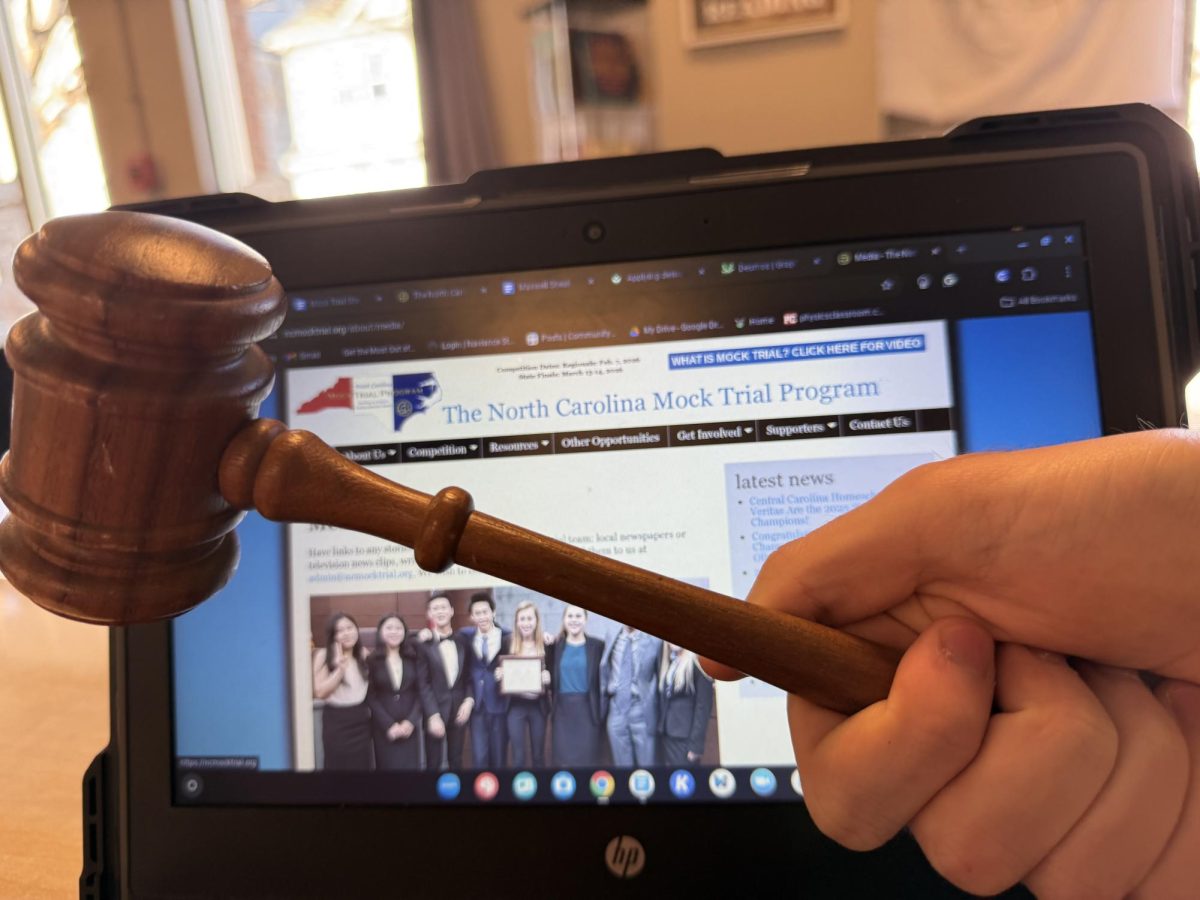
At the Community School of Davidson (CSD) High School, you can hear many students yelling “Objection!” in the American History room after school a few times a week. It’s not students upset over test scores or protesting homework, it’s the Mock Trial club hard at work.
Not many people are aware of the CSD Mock Trial club. It’s a small club that meets in Mr. Yodice’s room both during the school day and after school. Perhaps your memory may be jogged if you look at clubs in the yearbook, as the club dates back quite some time.
Mock Trial takes place after school on Mondays and Wednesdays, as well as on Fridays during 7th block.
The club overlaps with an elective class, “How To Argue Effectively” which is designed to educate students about the annual North Carolina Mock Trial competition, which prepares future law students and those interested in learning about the law and our judicial system.
The 3-day elective class used to be every Monday, Wednesday and Friday during school, but due to a new NC law that changes whether students receive .5 or 1.0 credit, and how many days they must be in class, CSD’s schedule changed. Extracurricular responsibilities, like sports or a part-time, make it harder for Mock Trial players, both new and old, to meet.
“I have yet to hear why there is a justification for taking away the half-credit courses. I would think that if a school could give more options to kids, they should give more options to kids,” Anthony Yodice, Mock Trial club leader and American History teacher, said. “Why would you take that away? Who was being hurt by that? It will effectively kill mock trials during the school day.”
Yet through these changes, morale has stayed strong. In fact, this year is one of the largest size clubs that Yodice has had in hosting the club. However, due to the recent legislation, it has made it harder to manage the new involvement. Underclassmen cannot fit it in their schedules.
This, combined with the period changes of the class, makes it more difficult for new students to gain more experience and for the club to get as much exposure and dedicated time while trying to balance the mock trial with other responsibilities.
Club and class member, Elena Cunningham (‘25), feels the change is impacting learning.
“We never have time to work on the case because we have class once a week at most, and we often have no school on Fridays. Having the class twice a week gave us more time to focus and get in a groove,” Elena Cunningham said, referring to the “How to Argue Effectively” class.
The club’s statewide organizing body also complicated competition this year. It was originally planned that CSD would field three teams at the beginning of the year: the JV Team, the Varsity Team, and the All-Star team (these names are misleading, though, because they range in experience over skill to prioritize students who have more experience to stick around for the club) but the state limited CSD’s involvement. A last-minute cut to the size of the allowed teams made it so that only the Varsity and an All-Star teams are able to compete this year.
Yodice sees it as a double edged sword.
“It’s a good thing that they’ve cut teams because the program has gotten so popular in the state, they’ve had to cap it at 120 teams,” Yodice said. “Our program was popular enough that we could only have three.”
Looking ahead, it will be interesting to see the direction Mock Trial takes in the upcoming months and years, as the majority of the team’s All-Star players are currently seniors (5 out of the 6).
Yodice has been the one who’s kept the club alive for the majority of the club’s history and, despite the changes in curriculum and team limit, remains optimistic about Mock Trial.
“The clubs are going to be just an after-school activity, but I do think it will have the traction to continue to grow,” Yodice said.